
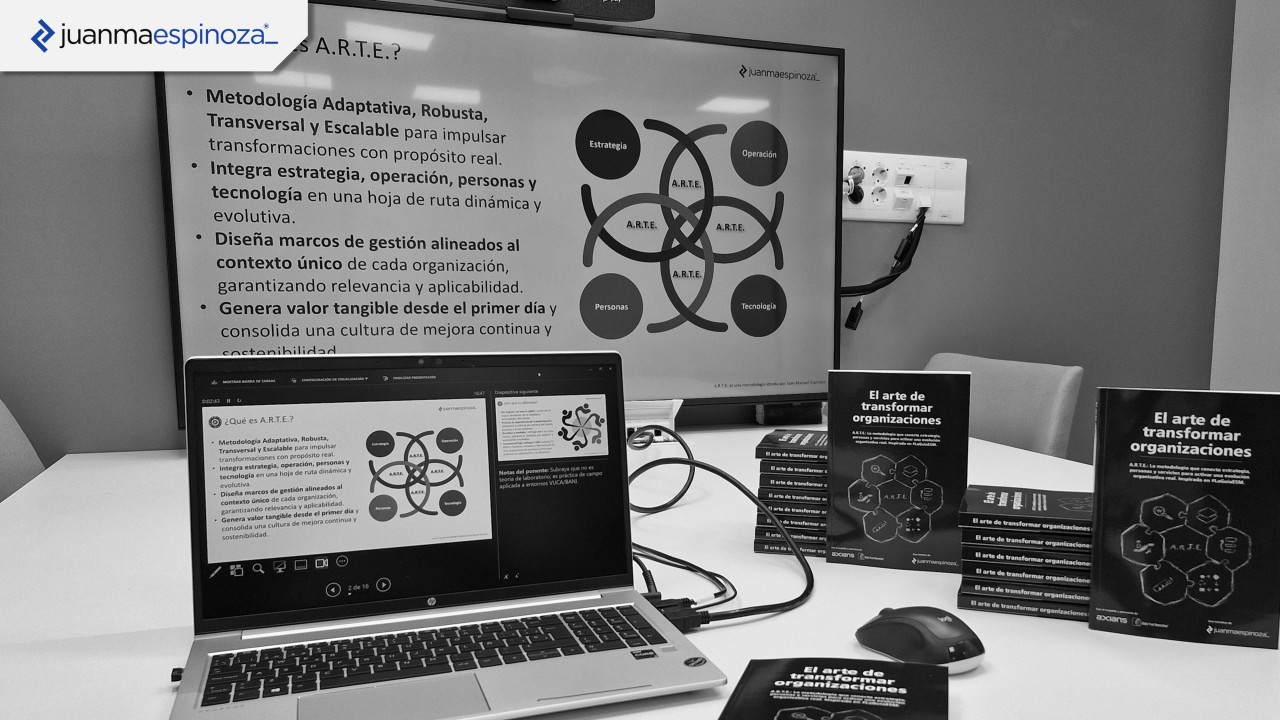
This is a reflection drawn from what I’ve lived, learned, and what I am still discovering, so I hope you enjoy it with the simplicity with which I try to share my perspective. Here we go…
There are ideas that try to explain how culture is formed within an organisation. One of them suggests that when a process is well designed, it can create an environment that encourages certain habits and, over time, consolidates a culture. It’s an interesting view, especially in contexts where structure and collective discipline allow processes to become behaviours almost naturally; and it certainly deserves respect, because it stems from a genuine intention: to understand how organisations work and how they can evolve.
However, after working in different countries and completely contrasting realities, with teams from highly diverse cultures and organisational contexts that have little in common, I’ve learned that the relationship between process, habit, and culture does not always behave linearly. In some places it works like clockwork. In others, the story is entirely different, and in many cases the key is not the process itself, but the emotional experience people live around it.
It seems to me that when you’ve had the chance to see (and both enjoy and suffer) how organisations transform across countries and continents, you understand that culture is not an engineering product but a human phenomenon. And therefore, it cannot be explained solely through the logic of design, but through the logic of lived experience.
“…Let’s say processes work because culture sustains them.”
In some places, for example, the coherence between process and habit is almost a (socio)cultural reflex. Collective discipline, respect for standards and the pursuit of continuous improvement mean that a well-designed process has a high probability of becoming daily practice. There, the process is not just a document; it becomes a way of “honouring the work and respecting the team”. In such a context, the idea that a process generates habits and habits generate culture fits naturally, realistically, and sustainably.
In other places something similar happens, though from a different angle. Procedural clarity, precision, and trust in structure make a well-defined process enough to trigger consistent behaviours. Not because people obey blindly, but because there is a shared expectation that the process is the best way to ensure quality and efficiency. There, culture rests on logic, and logic rests on process. Very characteristic indeed.
In countries, for example, where trust in the system is high and communication is direct, a clear process is often enough to activate consistent behaviour. People trust that the process exists to help, not to control. And that trust facilitates adoption and, why not say it, makes life easier itself.
In these contexts, as I said earlier, the process works because culture sustains it… not the other way around.
“…In many other places, the process is not enough, because experience leads the way.”
When you cross the ocean, the story changes (a lot). There, creativity in problem‑solving often coexists with mistrust of formal structures (even when we’re talking about laws and regulations). Most people are used to improvising, adapting, and finding solutions in the midst of chaos—something admired and even valued professionally in more structured societies. In such an environment, a flawless process may remain on paper if it doesn’t connect with the team’s reality, if it doesn’t respect their way of working, or if it doesn’t feel useful. In this context, the process doesn’t lead: it accompanies. And culture is not formed from structure but from shared experience (which is, in this case, more important).
Then there are other places where conversation, relationships, and context matter just as much as rules. Adoption happens when people feel something makes sense. It’s not enough for the process to be well designed; it must resonate emotionally. It must feel aligned with the team’s identity. It must integrate into the social fabric. There, culture is built in corridors, informal meetings, and in the trust between people. And a process only works when it becomes part of that conversation (not before).
I have had the opportunity to work with deeply human and reflective teams, and in these cases, the adoption of a process depends heavily on the narrative behind it. People want to understand the “why”, they want to see the purpose, they want to feel they are part of something bigger. When that happens, adoption is natural. When it doesn’t, the process is perceived as a burden. There, culture is activated through meaning… and if not, well, nothing happens.
In other environments, where critical thinking is part of the cultural identity, a process is only adopted when it passes the team’s intellectual filter. People want to debate it, understand it, question it. And once they make it their own, they defend it strongly. There, culture activates through reflection (and everything else becomes secondary).
And I could go on with examples that even include regions within the same country (everywhere, you just need to travel 200 km in any direction (north, south, east or west) and you’ll find different realities and conditions that change everything you assumed was “the standard”). Every society has its own way of activating change. In some, structure is enough. In others, emotion is essential. In others, relationships are everything; and in others, collective purpose is the main driver. There is no single formula, because there is no single culture (and there won’t be for a very long time…).
“…Behavioural science confirms what practice shows.”
Organisational psychology has been explaining this for decades. Edgar Schein, one of the leading experts on culture, argues that culture is a pattern of shared assumptions that a group learns while solving real problems. In other words, culture is not born from process but from experience. Neuroscience of change, in turn, shows that people adopt new behaviours when they feel psychological safety, when they perceive autonomy, when they find meaning. Not when they receive a diagram.
Self‑Determination Theory (Deci & Ryan) confirms this, stating that human motivation depends on three deeply emotional factors: autonomy, competence, and relatedness. If a process threatens any of these, resistance appears even if the design is impeccable.
And David Rock’s SCARF model adds that the human brain reacts with threat or reward depending on how it perceives status, certainty, autonomy, relatedness, and fairness. A process can trigger any of these dimensions—for better or worse.
All this leads to a conclusion that, though simple, completely changes how we understand transformation: culture does not change by decree; it changes through experience.
If you want to test it, try something very simple:
- Tell someone: “From now on, you must do it this way because it’s the process.” You’ll probably see micro‑gestures of doubt, resistance, or disconnection.
- Now try saying: “Can I show you a way that saves you time and makes your work easier?” You’ll see the reaction change completely.
- Or try this: “Which part of this process doesn’t fit your day‑to‑day work?” and listen. Culture begins there.
- Another simple experiment: “What would you need for this process to be useful to you?” The answer often reveals more about culture than any formal assessment.
- And one more, especially useful in relationship‑driven cultures: “How would you like this process to make you feel?” People don’t usually expect that question. But when they hear it, a door opens.
These small exercises show that culture is not activated through instruction but through the emotional experience that accompanies the instruction. A “small” detail, don’t you think?
When someone experiences a process as something that helps them, respects them, or simplifies their life, they adopt it. When they experience it as a burden, they avoid it. When they experience it as an imposition, they resist it. When they experience it as an opportunity, they embrace it; and when they experience it as something shared, they turn it into habit.
That’s why, rather than asking whether a process can create culture, we should ask what experience that process generates. Because that is the real lever of change—everything else is “smoke”, and yes, you can complicate your life in a thousand ways, but doing so is unnecessary and a bit absurd. If you have to do it, do it well, right?
And this is where A.R.T.E. becomes meaningful…
This reflection, born from years of work across multiple societies, is precisely what led me to develop A.R.T.E. Not as a rigid methodology, but as a logic that respects human complexity. A.R.T.E. starts from the idea that transformation is not imposed but built. That culture is not dictated but activated. That strategy is not executed from above but lived from within. And that each society, each team, and each person needs a different experience for change to make sense.
In the introductory chapter of A.R.T.E., I explain it clearly: “Transformation begins and ends with people.”
Later, in the chapter on shared narrative, I go deeper into how internal experience becomes a driver of change. Because A.R.T.E. does not seek for people to follow processes, but for them to experience something that makes those processes meaningful. In some places, A.R.T.E. relies more on emotional alignment. In others, on shared narrative. In others, on operational clarity. And in others, on co‑creation. But always with the same intention, as you well know by now: to make transformation human, sustainable, and coherent with its context.
Because ultimately, what truly changes culture is not the process itself, but the experience people have when living it. And when that experience is designed with sensitivity, purpose, and respect for cultural diversity, change stops being an effort and becomes evolution. That is, for me, transforming with A.R.T.E.
Thank you very much for reading this far, and I hope you enjoy “The art of transforming organisations”, where I explore what we know as the #ARTEMethod in detail. Remember that you can download the book for free here: https://juanmaespinoza.com/en/method-arte
A big hug, and have a fantastic week (always)! ✌🏻😊
