
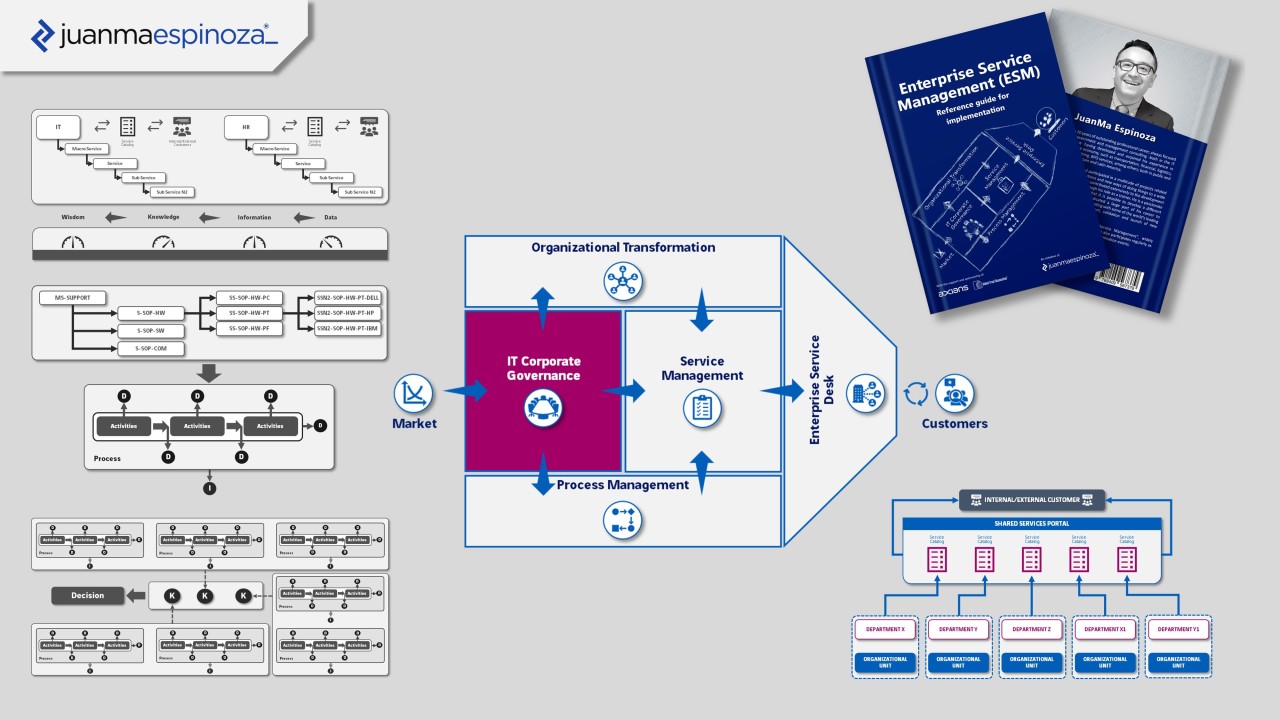
#TheESMGuide constitutes the first and only logical reference model worldwide explicitly designed for the implementation of Enterprise Service Management as an organisational system. Its approach transcends traditional operational and technological frameworks, integrating corporate governance, organisational transformation, service management, and process management into a coherent architecture oriented towards decision‑making, strategic alignment, and the generation of sustainable value.
When management needs direction.
If the trajectory of organisations that manage to evolve without losing coherence is observed carefully, it becomes evident that the true differentiator does not usually lie in the technology or in the methodologies adopted, but in the quality of the decisions that are taken consistently over time. That ability to decide with judgement, timeliness, and vision is precisely the territory of IT Corporate Governance within #TheESMGuide approach.
From its conception, #TheESMGuide argues that Enterprise Service Management cannot be built solely from operations. Nor from the extension of ITSM practices to the rest of the organisation. The proposal is more ambitious and, at the same time, more structural. It is about providing the organisation with a logical model in which strategy, transformation, services, and processes are aligned under a single rationale. For this to be possible, governance is not a later addition, but the starting point that gives meaning to everything else.
“…Enterprise Service Management only becomes meaningful when it is governed as a system, not operated as a collection of practices…”
Within this framework, IT Corporate Governance is not understood as a mechanism for technological control nor as a discipline oriented exclusively towards regulatory compliance. It is conceived as the system through which the organisation directs and controls the current and future use of its technological capabilities in order to achieve the results it has set out to reach. Put another way, it is the space where the most important question of all is answered whether the right things are being done, not merely whether they are being done well.
This distinction, apparently subtle, marks a profound difference. While management is oriented towards executing and optimising what already exists, governance is oriented towards deciding what deserves to be executed. When this function is not clearly defined, the organisation tends to operate in a reactive mode, responding to urgent and disconnected demands. When sound governance exists, management gains focus, legitimacy, and coherence.
Governance as the articulating axis of the model.
One of the distinguishing features of #TheESMGuide approach is that it does not present its disciplines as isolated compartments. Organisational transformation, IT Corporate Governance, Service Management, Process Management, and the Enterprise Service Desk are part of a single logical system designed to operate in an integrated manner.
Within this architecture, IT Corporate Governance acts as the articulating axis. It is the discipline that connects the strategic intent of the organisation with its real capacity for execution. Without it, services may be defined, and processes may be documented, but they will do so without a shared direction, exposed to fragmentation and loss of focus. Not as an additional hierarchical layer, but as the mechanism that ensures coherence and continuity across the entire system.
“…IT Corporate Governance is not an additional layer of control, but the mechanism that gives coherence and continuity to the entire organisational model…”
Governance is what establishes priorities, defines decision criteria, assigns responsibilities, and sets the boundaries within which management can operate. Thanks to this function, Enterprise Service Management ceases to be a catalogue of good practices and becomes a system oriented towards concrete and measurable objectives.
In addition, governance provides a common framework that makes it possible to align areas with different logics, languages, and rhythms. It is not about homogenising organisational complexity, but about equipping it with shared principles that facilitate coordination and prevent the proliferation of well‑managed but disconnected silos.
Demand, supply, and decisions with meaning.
At the core of #TheESMGuide model lies a fundamental idea the demand of the business must govern the supply of capabilities, and not the other way around. This principle, simple in appearance, takes on enormous relevance when translated into real decisions.
IT Corporate Governance is the space where this relationship between demand and supply is articulated consciously. It is there that the organisation decides which capabilities to develop, which services to prioritise, which investments to make, and which risks to assume. When this conversation is not governed, the organisation oscillates between two equally problematic extremes. Either technology imposes its possibilities on the business, or the business demands responses without understanding the real implications of its demands. In both cases, decisions are taken from urgency or availability, but not from value.
Governance makes it possible to balance this dynamic by incorporating criteria of value, sustainability, risk, and strategic alignment. In this way, Enterprise Service Management is built on reasoned decisions rather than on short‑term impulses or market fashions.
“..Without governance, service management may be efficient, but it will never be truly relevant…”
This approach is particularly relevant when organisations face processes of change. Organisational transformation, as proposed in #TheESMGuide, is not a one‑off act nor a closed project, but a continuous process that directly impacts culture, structure, and mindset. Attempting to manage this type of transformation without a clear governance system often leads to dispersed initiatives, poorly managed resistance, and fragile results.
Evaluate, direct, and monitor to sustain change.
The governance model that underpins #TheESMGuide is based on a simple, yet profoundly effective cycle evaluates, direct, and monitor. These three actions are not presented as administrative tasks, but as a continuous flow of organisational learning.
Evaluating implies understanding the context, external pressures, stakeholder expectations, and the coherence between the declared strategy and the real capabilities of the organisation. Directing means translating that understanding into clear policies, principles, and priorities that guide management. Monitoring makes it possible to verify whether the decisions adopted are producing the expected results and to adjust course when necessary.
This cycle gives the model an adaptive capability that is indispensable in complex and constantly changing environments. It allows the organisation to learn from its own decisions and to evolve without losing coherence. In this sense, IT Corporate Governance not only guides management, but also protects the model from constant improvisation and from paralysing rigidity, two of the main causes of failure in poorly conceived Enterprise Service Management initiatives.
Governing so that management makes sense.
Ultimately, within #TheESMGuide approach, IT Corporate Governance is not another module nor a superior layer distant from operational reality. It is the discipline that gives coherence to the whole, that articulates transformation, guides service management, and provides a shared logic to processes.
Without clear governance, Enterprise Service Management runs the risk of becoming an efficient but irrelevant exercise. With solid governance, the organisation is able to make better decisions, execute with focus, and sustain value over time. And it is precisely there where #TheESMGuide places the conscious exercise of transforming organisations, fully aligned with the vision developed in The Art of Transforming Organisations.
