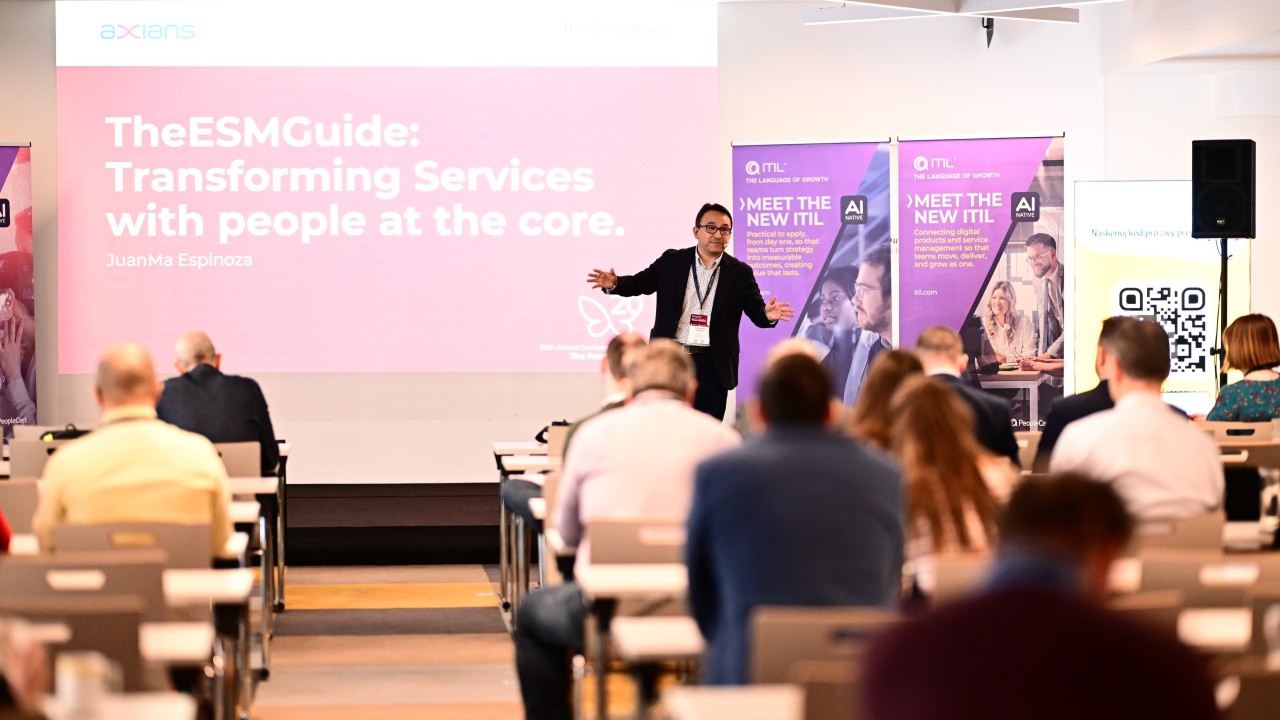
At the end of January 2026, I had the opportunity to take part in the annual itSMF conference in the Czech Republic. I travelled to Prague with a very clear intention: if I only had twenty‑five minutes in front of an expert audience, I didn’t want to talk about tools, frameworks, or trends. I wanted to talk about something far simpler and, at the same time, far more difficult to manage: People.
This article gathers (more calmly and with broader context) the core of the #THeESMGuide approach I shared with everyone. An approach forged through experience, through having accompanied organisations for two decades in transformation processes that only work when we understand that no model survives if it leaves people behind.

People first: Not as a slogan, but as a condition.
I began my presentation by saying something we often forget amidst so much methodology: the model I propose for implementing ESM (and anything else) only works when people want it to work. We can present the most complete catalogue, design the most elegant processes, or deploy the most advanced technological solution. But none of that matters if people don’t feel they are part of the change.
In transformation, the emotional outweighs the procedural. Resistance rarely arises because a process is poorly defined; it appears when that process creates uncertainty, or when people feel they haven’t been considered. However, when they feel heard, informed, and treated with respect, something unlocks. They open up. They engage. The organisation begins to move at a rhythm that no project plan can generate on its own.

ESM is not about IT: It’s about organisational identity.
Many view ESM as the natural evolution of ITSM. And yes, it has that root, but its impact goes much further. What ESM truly challenges is how an organisation understands itself.
Every area lives within its own logic: HR with its timing and sensitivities; Finance with its obsession for precision; Operations with its constant urgency; IT with its pursuit of stability. Each with its vocabulary, priorities, and fears. And ESM, when it arrives, does not simply propose common processes. It proposes a common way of understanding service.
Introducing a single service language transforms relationships. It brings clarity, reduces tension, eliminates misunderstandings, and creates something very powerful: shared identity. An organisation that speaks the same language begins to behave as a single system. And this transition, though technically complex on the surface, is fundamentally emotional.

The invisible fragmentation: When no one sees the whole picture.
One of the moments that resonated most with the audience was when I explained something we have all witnessed: when someone does not understand the impact of their work on the whole, it is natural for them to protect themselves. It is not selfishness; it is survival. In isolated departments, the priority becomes defending one’s own territory, minimising risk, and ensuring that “we’re not affected” by what happens elsewhere.
ESM acts directly on this fracture. It does not want every area to do the same; it wants every area to understand how it fits into the complete employee or customer experience. When that happens, behaviour changes. Collaboration stops depending on goodwill and begins to emerge from logic. From evidence. From traceability. And transformation finally stops being just rhetoric.

Change management: Support, not propaganda.
I have always argued that change management is not about writing communications or launching newsletters beginning with “Dear team…”. Change management is about supporting. It’s about caring. It’s about giving context.
In any transformation, people want three very basic things: to know early what is going to happen, to understand why it is happening, and to see that their leaders are genuinely committed. Nothing more, but nothing less.
When these three conditions are met, quick wins stop being a gimmick and become signs of trust: “Right, this works… I can walk with this.” Because, obvious as it may sound, people do not move forward when they feel pressured. They move forward when they feel hope.

The emotional curve of change: What never appears in the Gantt chart.
In Prague, I projected the classic emotional change curve. We all know it: shock, denial, frustration, confusion, acceptance, and so on. And I said something I’ve learnt from accompanying many teams: no one progresses through that curve because you explain the perfect process to them. They progress because they feel safe.
This is key. A transformation should not eliminate uncomfortable emotions, it should manage them. There are no shortcuts. Pretending to speed them up or ignore them only creates resistance. Supporting them, instead, generates real movement.

Sustaining the ESM model: Where technique meets trust.
One topic that generated particular interest was how to sustain the ESM model once the initial enthusiasm fades. And here I was very clear: technical components are essential, but insufficient.
Corporate governance only works if there is trust among those who participate in it. Processes are only followed if people believe they make their lives easier. Data is only used if it is perceived as a tool for improvement, not as a mechanism for surveillance.
Without trust, the ESM model becomes bureaucracy. With trust, it becomes culture. This is why, in any implementation, the Enterprise Service Desk, the corporate catalogue, and the BPM processes only come alive if people see meaning in them, if they bring clarity, reduce friction, and improve daily work.

The 90‑Day pilot: More than a project, a statement.
One message I wanted to emphasise is that a 90‑day pilot is not a technical test. It is a statement of intent. It exists to prove that transformation is not an abstract concept but something that materialises in visible results, better experiences, and teams that begin to function as the interconnected parts of a single system.
The order is non‑negotiable: first people, then processes, then data, and finally technology. When this order is respected, the pilot generates an energy that propels everything that follows. It is the moment when the organisation says: “This makes sense… let’s keep going.”

A.R.T.E.: A different way of transforming.
To give life and meaning to this proposal, I also presented the A.R.T.E. method not as yet another methodology, but as a way of understanding how organisations evolve and how to “activate” the dynamics of change. A.R.T.E. is adaptive because context changes; robust because people need certainty; transversal because real organisations work between areas, not within them; and expandable because a transformation is never truly finished.
A.R.T.E. works because it respects the natural way in which people learn and adapt. It does not force transformation: it accompanies it. It makes it livable.

When the model becomes culture.
#TheESMGuide and the A.R.T.E. Method were created with a simple goal: for transformation not to remain as a document but to become a shared experience. A transformation becomes real when people can say: “I understand it, I believe in it, I am part of this.” That is the moment when the model stops being a framework and becomes culture.

Conclusion: Nothing changes if people don’t change.
I ended my presentation with a sentence that summarises my entire approach: technologies do not transform, processes do not transform, methodologies do not transform; people do. And if we treat them with clarity, respect, and purpose, they will always (absolutely always) take us further than any tool or model.
I hope you really liked the approach, and that you can replicate it in any of your projects and services. Remember that you can download the #ARTEMethod from here, and #TheESMGuide from here.