
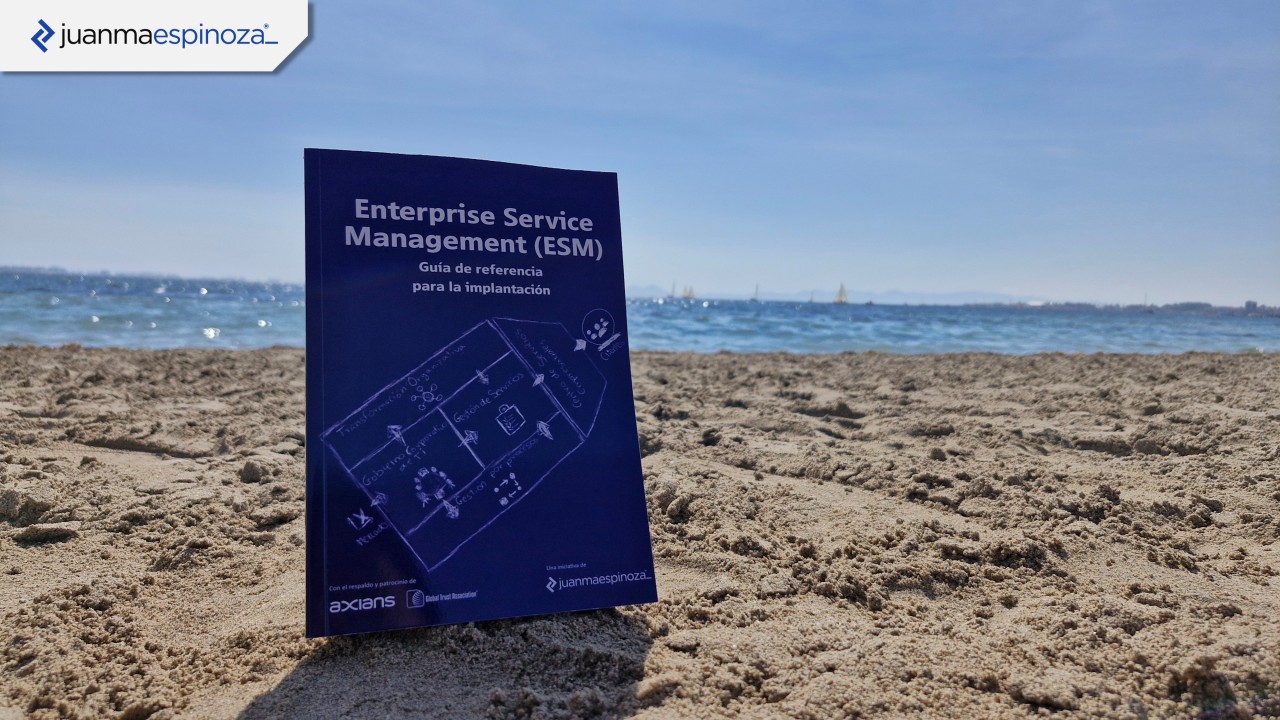
Enterprise Service Management (ESM) is no longer merely an extension of ITSM—it has evolved into a strategic discipline that redefines how organisations design, deliver, and improve their services. This article explores its origins, evolution, international recognition, and introduces #TheESMGuide (“Reference Guide for the Implementation of Enterprise Service Management”, Madrid 2023. ISBN 13: 978-84-09-56737-9), the first professional model for its deployment. A guide that has inspired the development of the A.R.T.E. methodology, designed to activate transformation with purpose, structure, and humanity.

Where does ESM come from and why does it matter?
Enterprise Service Management (ESM) emerged as a response to an increasingly evident organisational need: to apply service management logic beyond the IT department. Initially perceived as an extension of ITSM, it now represents a profound evolution in how organisations design, deliver, and improve their internal services.
Departments such as Human Resources—managing onboarding, training, and talent development; Finance—handling budgeting, payments, and expense control; or Logistics—coordinating deliveries, warehouses, and suppliers, are clear examples of functions that operate as genuine service providers. However, they often do so without a shared logic, lacking traceability, clear indicators, and a culture of continuous improvement.
ESM proposes a cross-functional transformation: turning each department into a professional service provider, with defined processes, clear roles, measurable indicators, and a focus on the internal customer. This not only enhances efficiency but aligns the entire organisation under a shared logic of value—a logic that gave rise to the A.R.T.E. methodology, inspired by #TheESMGuide, to connect strategy, people, and services in real organisational evolution processes.
Endorsed by the Giants: Gartner, Forrester, IDC
Over the past few years, leading international consultancies have acknowledged the potential of ESM. Forrester, for instance, as early as 2017, defined it as the application of ITSM principles to formalise and automate non-technological services. Gartner, IDC, and other firms have followed suit, positioning ESM solutions within their leadership quadrants and recognising their impact on digital transformation.
However, the true value of ESM does not lie in the technological tools that enable it, but in the shift in mindset it promotes. It involves moving from a departmental logic—where each area operates in isolation—to a logic of shared, measurable, and improvable services. This allows, for example, the Procurement department to have a clear catalogue of services (supplier requests, contract management, offer evaluation), which can be requested, tracked, and assessed by other departments, just like an IT service.
This approach breaks down silos, enhances interdepartmental collaboration, and enables leaders to make decisions based on real operational data.

More than an evolution of ITSM
It is clear that reducing ESM to “an evolution of ITSM” is to misunderstand its true scope. ESM is not merely a technical extension—it is an organisational transformation. It entails adopting a logic of corporate governance, process management, change culture, and a vision of services as strategic assets—a conceptual foundation that inspired the birth of A.R.T.E.: a methodology that translates #TheESMGuide into structured, emotional, and scalable action.
For example, in an industrial company, the Maintenance department can manage its services (machinery inspection, incident response, planning of technical shutdowns) under an ESM model, with compliance indicators, internal customer satisfaction metrics, and continuous improvement. This ensures that its operations align with production and quality objectives, not merely its own internal efficiency.
ESM requires structure, culture, and a shared logic that enables all departments to speak the same service language. And that is what makes it a true tool for transformation.

The moment of change: Data-Driven Organisations
As we well know, we are living in an age of immediacy and data-driven decision-making. Organisations that do not generate useful, traceable, and actionable information are doomed to operate blindly. ESM becomes the ideal vehicle to overcome this challenge.
A corporate service portal, where any employee can request services from IT, HR, Finance, or Legal, enables centralised demand, response time measurement, service quality evaluation, and bottleneck detection. A well-defined and managed cross-functional service catalogue allows organisations to know what each department offers, how services are requested, who approves them, and how they are measured. An Enterprise Service Desk enables all of this to be operated in an integrated manner, with traceability and control.
Each interaction becomes a source of value. Each data point collected enables improvement. Each delivered service can be evaluated. ESM transforms internal operations into a machine for generating organisational intelligence.

#TheESMGuide: The missing model
Until recently, there was no professional model to guide the implementation of ESM within organisations. #TheESMGuide (“Reference Guide for the Implementation of Enterprise Service Management”) is the first and only model worldwide, independent of vendors, that addresses this need in a structured, practical, and applicable way.
Developed with an orchestration mindset, this guide integrates disciplines such as organisational transformation, corporate IT governance, service management, process management, and Enterprise Service Desk operations. It is not a theoretical framework nor a collection of isolated best practices. It is a flexible, in-depth, and results-oriented model that enables any organisation to activate its transformation using derivative methodologies such as A.R.T.E., which adopt #TheESMGuide as a conceptual framework and turn it into an operational roadmap.
What is #TheESMGuide and why is it so powerful?
#TheESMGuide is a comprehensive model that enables organisations to implement ESM in a professional, structured, and sustainable manner. Its approach combines strategy, processes, organisational culture, and technology—covering everything from service catalogue definition to Enterprise Service Desk operations. Its advantages are numerous: it improves operational efficiency, generates data for intelligent decision-making, aligns all departments with business objectives, and adapts to any sector or organisational size. Its strength lies in its real-world applicability, conceptual depth, and practical focus. It is an essential tool for any organisation seeking to evolve towards a logic of enterprise services, where each department becomes a provider of value.

Comparison with the most widely accepted ITSM Frameworks
When we consider traditional frameworks such as ITIL4 and ISO/IEC 20000:2018, we see that they have been instrumental in professionalising IT service management (ITSM). However, their capacity for organisational transformation is limited outside the technological domain. #TheESMGuide represents a qualitative leap forward: a model designed from the outset for the entire organisation, with a practical focus, real-world applicability, and the ability to generate measurable value. It is the tool that enables organisations to become true service factories, where each department operates with a professional logic, focused on the internal customer and aligned with strategic objectives. Let’s compare some key aspects:
Organisational Focus
- ITIL4: Although it has evolved towards a more holistic vision with the Service Value System, it remains strongly anchored in IT. Applying it outside the technological domain requires interpretation and adaptation.
- ISO/IEC 20000:2018: Establishes requirements for a service management system applicable to any organisation, but its normative approach limits operational flexibility.
- #TheESMGuide: Designed with a cross-functional vocation. From the outset, it considers service management across all business areas—HR, Finance, Procurement, Legal—with specific examples and pathways for each.
Example: In a retail company, the HR department can use #TheESMGuide to define services such as “Onboarding Request”, “Holiday Management”, or “Performance Evaluation”, with clear workflows, roles, and metrics. ITIL or ISO20000 would require adaptation to achieve something similar.
Practical Applicability
- ITIL4: Offers principles and practices, but its implementation requires operational translation. It does not include detailed guidance for non-IT areas.
- ISO/IEC 20000:2018: Very useful for certification and auditing, but not prescriptive in terms of how to implement specific services.
- #TheESMGuide: Includes steps, examples, tools, and roles to implement ESM in any department. Its practical approach reduces ambiguity and accelerates results.
Example: The Procurement department can define services such as “Supplier Registration”, “Quotation Request”, or “Contract Management”, with indicators for response time, internal customer satisfaction, and regulatory compliance. #TheESMGuide provides a structure for this; ITIL and ISO20000 do not directly offer it.
Impact on Organisational Transformation
- ITIL4: Promotes continuous improvement and a service culture, but its impact depends on IT’s maturity and its ability to influence other departments.
- ISO/IEC 20000:2018: Provides order and control, but does not directly drive cultural transformation or interdepartmental collaboration.
- #TheESMGuide: Designed to transform the organisation through a logic of shared services. It fosters collaboration, cross-functional measurement, and alignment with strategic objectives.
Example: In a financial services company, integrating Finance, Legal, and IT under an ESM model enables management of services such as “Expense Approval”, “Contract Review”, and “Technical Support” from a single portal, with traceability and control. #TheESMGuide facilitates this integration; traditional frameworks do not explicitly address it.
Value and Data Generation
- ITIL4: Introduces the concept of value, but its metrics are primarily focused on IT.
- ISO/IEC 20000:2018: Requires the definition of metrics, but does not guide how to generate value from non-IT departments.
- #TheESMGuide: Proposes indicators oriented towards business, operational efficiency, and internal customer experience. It enables the generation of actionable data for decision-making.
Example: The Legal department can measure response times for contract reviews, identify bottlenecks, and improve the business experience. #TheESMGuide provides this logic; ITIL and ISO20000 do not develop it for functional areas.
Flexibility and Evolution
- ITIL4: Flexible in theory, but applying it outside IT requires conceptual effort.
- ISO/IEC 20000:2018: Rigid in its normative structure—useful for auditing, but limited for agile evolution.
- #TheESMGuide: A modular, adaptable, and evolutionary model that can scale according to the maturity of each department and the organisational context.
Example: A startup may begin with a basic service catalogue in IT and HR, and scale towards a full ESM model as it grows. #TheESMGuide enables this progressive evolution.
Conclusion
Enterprise Service Management is no longer an emerging trend—it is a strategic necessity for organisations seeking efficiency, traceability, and real alignment across departments. Traditional frameworks such as ITIL or ISO20000 have been essential in professionalising IT service management, but their scope and applicability outside the technological domain are limited.
#TheESMGuide (“Reference Guide for the Implementation of Enterprise Service Management”) represents a new paradigm: a professional, cross-functional, and profoundly useful model that enables any organisation to operate under a logic of shared, measurable, and value-oriented services.
In an environment where every department must act as an internal provider of excellence, #TheESMGuide becomes the key tool to transform operations into intelligence, collaboration into results, and management into competitive advantage. All of this, through a professional logic as proposed by the A.R.T.E. methodology, inspired by #TheESMGuide —transforming with method, with vision, and with humanity.
Remember, you can download #TheESMGuide free of charge by scanning the QR code or visiting https://juanmaespinoza.com/en/enterprise-service-management-en/
